

May 25, 2005
Parts, parts, parts
I’ve been busy for the past several days, working on a brand new set of parts for the original orchestra version of Redline Tango. (The Minnesota Orchestra needs the revised parts within the next 10 days. As a little shout-out to the conductor, Andrew Litton, I have to thank him for fighting to program Redline Tango — the only piece by a living composer for the entire summer season.)
As I wrote here a while back, when I made the wind version, I simplified a lot of notation, just to make it easier to read. (Warning: it’s going to get pretty theory-centric for a few paragraphs…) The notes were the same, and the effect was the same, but it just looked less complicated. It was that experience that finally taught me that my first instinct about metric notation may not be the right one. For example, in the original version, there were lots of meters in 12/16, coming after meters like 5/8. To me, the pulse really was changing to four dotted-8ths per bar, but the orchestra players saw 5/8 followed by 12/16 and had to quickly think, “is the pulse changing? Is the 8th-note constant, or is there a metric modulation here? How is this 12/16 bar divided? Is it in 4 beats, or something weirder?” And they asked themselves these questions while they were sight-reading a piece with a tempo of quarter note=132. In short, it made the piece a bitch to read.
So I changed all of the 12/16 bars to either 6/8 or 3/4, depending primarily on the meter proceeding or subsequent to that bar. For example, if the previous bar is in 5/8 — divided into 2+3 — I put the 12/16 bar in 6/8, because the musicians are counting a beat of three 8th notes right before that measure. If the measure before is in 5/4, I put the 12/16 bar in 3/4.
Another change was my notation of staccato notes. I’d often put a 16th-note followed immediately by a 16th-rest. In the revision, I changed those to 8th-notes with staccato marks. It’s hard to argue that there’s any audible difference at this tempo, but it makes the music look a lot simpler, and that makes the piece a lot easier to play, and that means it can be done in less rehearsal time.
So I’m taking all of those notation changes that I made on the band version, and I’m putting them back into the orchestra version. (There are other changes, like a few scoring changes to fix some orchestration that never quite worked, but the bulk of the differences are notational.) That’s why Litton agreed to program it this summer — because he could put it together quickly and easily.
Unfortunately, as of now, I won’t be at the Minnesota Orchestra’s performance in July. The orchestra, like most, is broke, and they can’t afford to bring me out. This speaks volumes about why orchestras are sickly. I’m the only not-dead composer on any of their summer concerts, and I have ties to the community (having had a Music Alive residency with the youth orchestra there in 2002-2003), and they won’t fly me there to speak to the audience and do whatever else they might want me to do. Granted, I want to go for selfish reasons, too — it’s fun working with Andrew, and I think the performance will be pretty spectacular, and I rarely hear the orchestra version. It’s a shame.
Ravel was charming and a good dresser, but he’s dead, and can’t attend anyway. I’m alive (plus I have a nice suit!), and this will be the premiere of the revised version of the piece, and the orchestra can’t find a way to fly out the only not-dead composer on the summer program.
This, after my amazing experiences with wind ensembles this season, is terribly disappointing by comparison.
May 18, 2005
So far, so good!
I’m back home in NY, and the weather is beautiful. It’s nice to be home, and I’m just about settled-in and caught up on most of my “to-dos.”
I spent most of yesterday hooking up my new computer. As you may have read here, I had some problems with my old system. Apple ended up replacing everything, and I picked it all up yesterday morning. It took a little time to undo some of what they did at the store, but I think it’s all working now.
In case you’re interested — I’ve had requests for this recently — I’ve posted a list of the equipment that I’m using. If you want to see it, click here. The fun part about making that list was the web search for a link to my digital piano. I didn’t find a picture of my actual model (the link is to the next model up), but I did determine that my keyboard was built in 1987. I knew it was old, but I had no idea that I’ve had it for almost 20 years! Korg makes a fine product.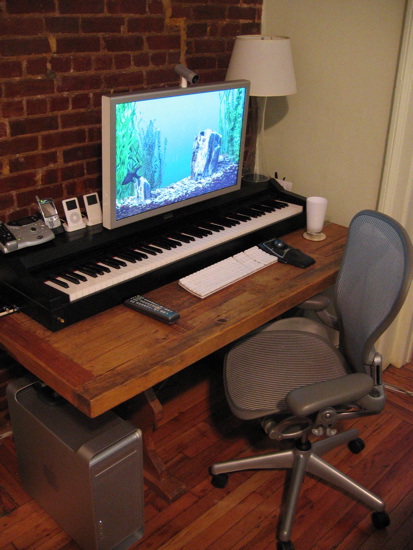
As I write this, I’m listening to the CD that Paul Moravec gave me a few weeks ago. This is great stuff. I’m especially digging the “Scherzo.”
I think I’ll head out for a run. That is, if Loki, who seems to have missed having a daytime playmate while I was away, will let me out the door…
View Comments
Comments
HI Mr.Mackey this is Isaac (the ukulele player from SYSO) I wrote you an e-mail regarding the music i was hoping to recieve from you and I was just curious if you recieved it, if not you can e-mail me at ijkcastillo@hotmail.com thanks again.
Add comment
May 15, 2005
Goodbye, Seattle
My residency with the Seattle Youth Symphony Orchestra has come to a close. This afternoon was the season’s final concert at Benaroya Hall (and the Music Director, Huw Edwards’s, final concert as their conductor). As much as I grew increasingly homesick with all of the travel this season (Seattle, Tallahassee, Phoenix/Tempe, Dallas, San Antonio, Seattle again, Los Angeles, Lawrence (Kansas), Beaumont, and back to Seattle — each with a trip back to New York in between), I’m going to miss Seattle. I think I had a hard time here in the beginning because I didn’t know my way around at all, but once I figured out places to go running, where to get great coffee, where to get free WiFi, and where to get the best sushi, I started feeling a little more comfortable.
What really made the difference, though, was the orchestra. I’ve had two performances in as many months where the final dress rehearsal of my piece nearly brought me to tears. (It doesn’t ever happen in concerts, because I’m far too nervous during actual performances.) The first time was at Lamar University, where a very light piece — Sasparilla — was played with such dedication that I was sincerely moved. The same thing happened today. “Antiphonal Dances” isn’t an easy piece, but the group played damn near flawlessly. That wasn’t what made it so special, though, because I’ve been fortunate to get a lot of amazing performances this year. What was so amazing was that this group seemed to really love playing this piece.
Whenever Huw would say during rehearsals, “next up, The Mackey,” I’d hear an audible expression of true excitement from the group. Then, when they played, you could hear (and see) that positive energy. Watching them work, I could totally tell what parts of the piece really “worked,” just based on the facial expressions and body language of the players. And after they nailed something, the section would look at each other with a “yeah, we kicked ass on that” glance. This group just completely “got” this piece.
And the dress rehearsal was crazy. Maybe it was the amazing hall, and finally hearing all of the antiphonal players balanced just the way I wanted, or maybe it was knowing that the residency was coming to a close, but something in the way they played the piece felt like they wanted to give me the best sendoff they could. It was like 90 musicians were all saying “we love you!” at quadruple-forte. Anyway, I started to cry. Fortunately, I was able to regain my composure by the time the last measure arrived. Otherwise, they’d never again see me as the jaded New Yorker I pride myself in being.
Several people after the concert told me that the performance had brought them to tears, too, but I truly don’t think it was the piece — it was the performance. I’m not being modest; the reason this piece worked tonight was because of each of those musicians. It was the kind of performance that makes me feel incredibly fortunate to be a composer.
I couldn’t have asked for a better close to the concert season, or a better send-off from this residency in Seattle.
View Comments
Comments
First of all, it was hilariously funny that you actually told the audience our plot line. That was so great.
Second, we were all pretty annoyed that we couldn't end the season with your piece. The Harris was such a boring piece, and my stand partner honestly said the Antiphonal Dances were the coolest piece he has ever played.
You made this concert enjoyable. You deserve a medal for that.
This is Isaac (pauls stand partner)((the one who sends you e-mails)) And I would have to agree that lots of people wanted to play your piece last simply because its so damn good.
That made me smile.
That made me smile!
((This is a cellist from the YSO section, 4th))
As it has been said before, Antiphonal Dances really made the concert. It is a pity we could not play yours last, especially concerning the excellent audience reaction (as compared to that of the Harris). We (speaking for the cello section) really LOVED the first movement, if you couldn't tell. : ) We also wanted to tell you that we added a slide/gliss, if you did not notice, in measure 51 from the f to the a. Once in a rehearsal the front stand just added it on a whim, and we decided it was a justifiable change. After all, you can't give all the slides to the violins- that would be just plain wrong.
I really hope you look into doing some more orchestral or string orchestra pieces- they are some of my favorites of your work. That and Wrong Mountain Stomp- I love the blend of fiddle with modern rhythm! You music is a joy to play, and hope to perform your work as a professional some day as well. Thank you!
-l
p.s.- Is it possible to get a recording of Wrong Mountain Stomp? I think I'm wearing out the connection on iTunes...
I also agree that we should have played Antiphonal Dances last!
P.S. You're cute! bwahaha
View Comments
Comments
Anonymous says
You do have a nice suit.
Isaac Castillo says
sounds like you enjoy confusing the crap out of your players...but its always really fun to play
Add comment